Juice and smoothie bar checklists (free template)
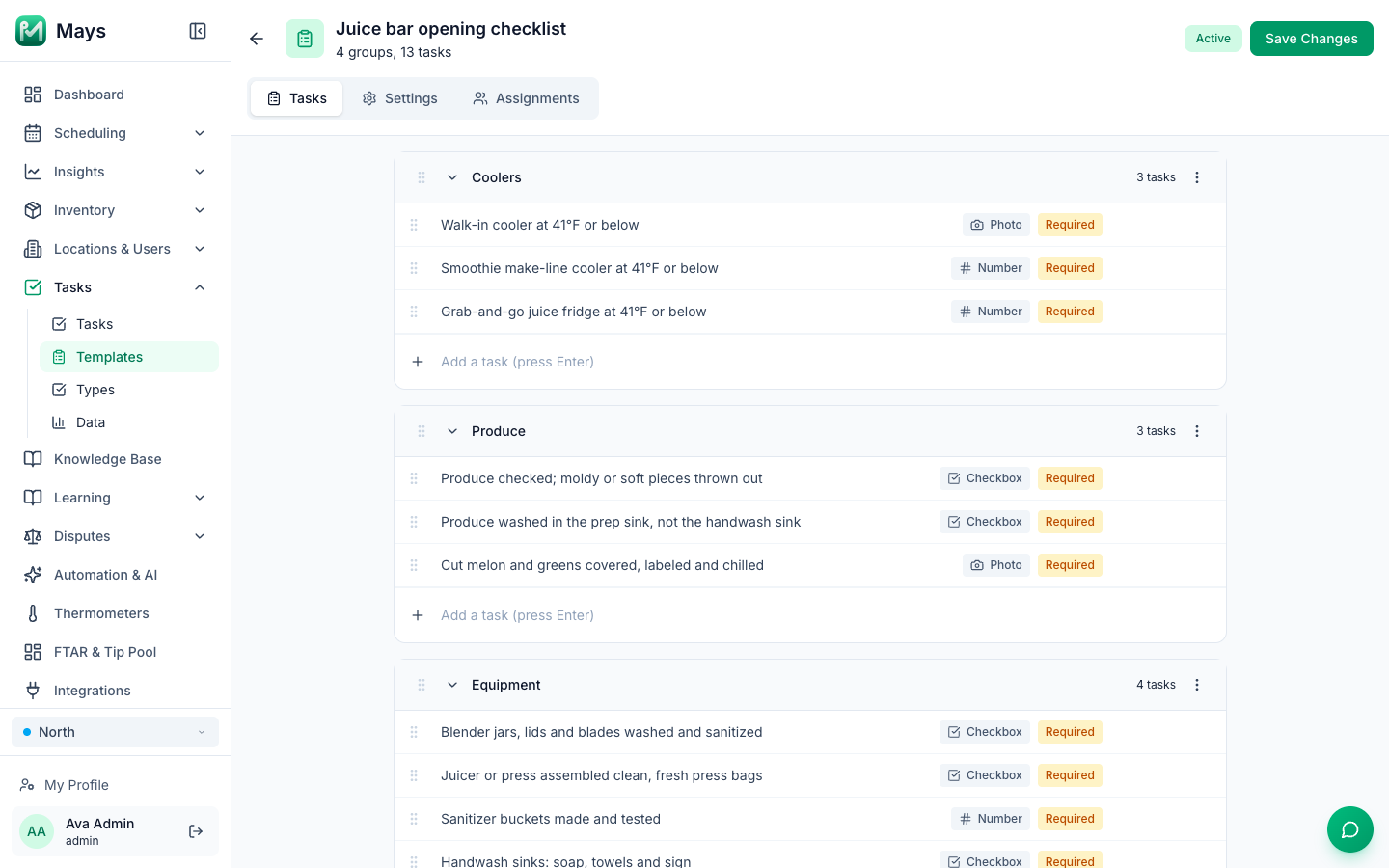
A juice bar looks simple from the counter: fruit, a blender, a press. Behind it are raw produce that's never cooked, cut melon and greens that have to stay cold, blenders that go from a peanut-butter smoothie to a "nut-free" one in seconds, and bottles in the grab-and-go fridge with their own federal rules.
This template is for a juice and smoothie bar that cuts its own produce, blends to order and presses juice on site. Every task has a Who and a Proof (photo, number or checkbox). Our checklist guide covers how to write tasks people follow.
This is general information, not legal advice. Your inspector, and for bottled juice the FDA's rules, have the final word. Updated September 24, 2026: the FDA pages and regulations quoted here were re-checked.
What makes a juice bar list different
In Florida, DBPR licenses restaurants and fast-food service and FDACS licenses bakeries, grocery and convenience stores (DBPR: Who needs a license?), so ask which one covers your setup. DBPR enforces the 2017 FDA Food Code; FDACS has used the 2022 edition since April 22, 2026. The sections below read the same in both.
- Produce is washed before it's cut. Raw fruit and vegetables are thoroughly washed in water before being cut, combined with other ingredients or served ready to eat (§3-302.15(A)).
- Some cut produce must stay at 41°F. Cut melons, cut leafy greens (spinach and kale included) and cut tomatoes are TCS foods under the Food Code's definition, so they're held at 41°F or below (§3-501.16(A)(2)). Holding all cut fruit that way is simpler than remembering which is which.
- Time instead of temperature is allowed, with rules. Cut fruit kept out on the line can be controlled by time for up to 4 hours: it starts cold (the Food Code sets the starting temperature), containers are marked with the discard time, it's thrown out at 4 hours, and written procedures are on file for the inspector (§3-501.19).
- Blenders get cleaned on a clock. Equipment is cleaned between uses with raw fruit and vegetables and TCS food, and at least every 4 hours when it's used with TCS food like milk, yogurt or cut melon (§4-602.11(A)(3), (C)).
- Allergens ride in the blender. Nut butters, milk and soy go through the same jars as everything else. The Food Code expects staff to be trained in food allergy awareness for their duties (§2-103.11). A separate, washed jar for allergy orders is the practical answer.
What the FDA juice rules mean for you
Cold-pressed juice has its own rules, and which ones apply depends on how you sell it.
How you sell it | What applies |
|---|---|
Only directly to your own customers | The Juice HACCP regulation (21 CFR Part 120) doesn't cover a "retail establishment": an operation that provides juice directly to consumers, including storing, preparing, packaging, serving and vending, and doesn't also sell or distribute juice to other businesses (21 CFR 120.3; FDA's Small Entity Compliance Guide). |
By the glass, made to order | The FDA "does not require warning labels for juice or cider that is sold by the glass", naming juice bars as an example (FDA: juice safety). |
Bottled on site for your grab-and-go fridge | Juice packaged in a food establishment is either treated under a HACCP plan to a 5-log (99.999%) reduction of the most resistant microorganism of public health significance, or labeled with the ingredient label and this warning (Food Code §3-404.11; 21 CFR 101.17(g)): "WARNING: This product has not been pasteurized and, therefore, may contain harmful bacteria that can cause serious illness in children, the elderly, and persons with weakened immune systems." The FDA adds that these untreated products should be kept refrigerated. |
Also to gyms, cafés or grocers | You're no longer only a retail establishment, so Part 120 applies, starting with a written hazard analysis. The FDA's guide is blunt: "Only retail establishments are exempt." Talk to the FDA and your licensing agency before you sign that first wholesale order. |
The same regulation sets how the warning looks: prominent on the label, "WARNING" in capitals and bold, and the statement set off in a box of hairlines (21 CFR 101.17(g)(4)–(6)).
The template
Opening checklist (visible 6:00 to 8:00 am)
Group | Task | Who | Proof |
|---|---|---|---|
Coolers | Walk-in cooler at 41°F or below | Opener | Photo |
Coolers | Smoothie make-line cooler at 41°F or below | Opener | Number |
Coolers | Grab-and-go juice fridge at 41°F or below | Opener | Number |
Produce | Produce checked; moldy or soft pieces thrown out | Prep | Checkbox |
Produce | Produce washed in the prep sink, not the handwash sink | Prep | Checkbox |
Produce | Cut melon and greens covered, labeled and chilled | Prep | Photo |
Equipment | Blender jars, lids and blades washed and sanitized | Opener | Checkbox |
Equipment | Juicer or press assembled clean, fresh press bags | Opener | Checkbox |
Equipment | Sanitizer buckets made and tested | Opener | Number |
Equipment | Handwash sinks: soap, towels and sign | Opener | Checkbox |
Front of house | Unpasteurized bottles carry the FDA warning label | Shift lead | Photo |
Front of house | Allergen notes up for nut butters, milk and soy | Shift lead | Checkbox |
Front of house | Drawer counted and starting cash entered | Shift lead | Number |
Mid-shift checks (around noon)
Task | Who | Proof |
|---|---|---|
Make-line cooler at 41°F or below | Shift lead | Number |
Blender jars washed (at least every 4 hours) | Staff | Checkbox |
Time-marked fruit past 4 hours thrown out | Shift lead | Checkbox |
Sanitizer bucket changed and tested | Shift lead | Number |
Pulp bins and trash emptied | Staff | Checkbox |
Only use the "time-marked fruit" line if you've written a time-as-a-control procedure. Otherwise, everything cut stays in the cooler.
Closing checklist (visible from 6:30 pm)
Group | Task | Who | Proof |
|---|---|---|---|
Equipment | Juicer or press taken apart, washed, sanitized, air-dried | Closer | Photo |
Equipment | Press bags washed or replaced per manufacturer | Closer | Checkbox |
Equipment | Blender jars, lids and tampers washed and sanitized | Closer | Checkbox |
Equipment | Blender bases and make-line lids wiped | Closer | Checkbox |
Equipment | Floor drain under the juicer cleared of pulp | Closer | Checkbox |
Food safety | Cut produce covered, labeled, chilled; old prep thrown out | Closer | Photo |
Food safety | Today's juice bottled, labeled and dated, or discarded | Closer | Checkbox |
Food safety | Walk-in and juice fridge at 41°F or below at close | Closer | Number |
Close | Counters and floors cleaned; trash out | Closer | Checkbox |
Close | Drawer counted and total entered | Shift lead | Number |
Close | Doors locked, alarm set | Shift lead | Photo |
Weekly deep clean (Monday, carried through the week)
Task | Who | Proof |
|---|---|---|
Juicer screens, seals and gaskets cleaned per manufacturer | Shift lead | Checkbox |
Blender blades and gaskets checked for wear | Shift lead | Checkbox |
Ice machine cleaning date checked against the maker's schedule | Shift lead | Checkbox |
Under and behind the make-line cooler cleaned | Closer | Photo |
Produce cooler shelves washed; oldest stock in front | Prep | Checkbox |
Bottle labels checked against current recipes | Manager | Checkbox |
Temperature checks at a glance
What | Limit | Food Code |
|---|---|---|
Cut melon, cut leafy greens, cut tomatoes | 41°F or below | TCS definition, §3-501.16(A)(2) |
Milk, yogurt and other dairy on the make line | 41°F or below | §3-501.16(A)(2) |
Cut produce controlled by time instead | Discarded 4 hours after leaving the cooler, containers marked | §3-501.19 |
Prepped ready-to-eat TCS food kept over 24 hours | Date-marked, 7 days at most, prep day is Day 1 | §3-501.17(A) |
Juice bottled on site and not treated to a 5-log reduction | Warning label; keep refrigerated | §3-404.11; FDA juice safety page |
Adapt it to your bar
- No press? Drop the juicer and press-bag lines and the bottle-label checks.
- Smoothies only with frozen fruit? Keep the freezer on the opening list and the blender clock on the mid-shift list.
- Your juicer's manual wins on screens, seals and how long parts soak.
- Two readings a day aren't enough in a hot week. Add a second group to the mid-shift checks for the afternoon.
Load it into Mays
Each list is one template. In the block below, a # line is a template name, a [bracketed] line is a group, and every other line is a task.
- Tasks → Templates → Create Template. Type the name, click Continue.
- Add Task Group, then click New Group and type the group name.
- Paste one task line into Add a task (press Enter) and press Enter. Repeat line by line; the box takes one task at a time, so a multi-line paste lands as a single task.
- Click Checkbox next to a task to set Photo or Number from the Proof column.
- Settings: Frequency (Daily, or Weekly on one day with Carry unfinished duties through the week for the deep clean) and the Visibility Window.
- Assignments: click your location, pick A role or department or Specific people, then Create Template.
The image at the top of this post is the opening checklist, built from this block.
# Juice bar opening checklist
[Coolers]
Walk-in cooler at 41°F or below
Smoothie make-line cooler at 41°F or below
Grab-and-go juice fridge at 41°F or below
[Produce]
Produce checked; moldy or soft pieces thrown out
Produce washed in the prep sink, not the handwash sink
Cut melon and greens covered, labeled and chilled
[Equipment]
Blender jars, lids and blades washed and sanitized
Juicer or press assembled clean, fresh press bags
Sanitizer buckets made and tested
Handwash sinks: soap, towels and sign
[Front of house]
Unpasteurized bottles carry the FDA warning label
Allergen notes up for nut butters, milk and soy
Drawer counted and starting cash entered

# Juice bar mid-shift checks
[Checks]
Make-line cooler at 41°F or below
Blender jars washed (at least every 4 hours)
Time-marked fruit past 4 hours thrown out
Sanitizer bucket changed and tested
Pulp bins and trash emptied

# Juice bar closing checklist
[Equipment]
Juicer or press taken apart, washed, sanitized, air-dried
Press bags washed or replaced per manufacturer
Blender jars, lids and tampers washed and sanitized
Blender bases and make-line lids wiped
Floor drain under the juicer cleared of pulp
[Food safety]
Cut produce covered, labeled, chilled; old prep thrown out
Today's juice bottled, labeled and dated, or discarded
Walk-in and juice fridge at 41°F or below at close
[Close]
Counters and floors cleaned; trash out
Drawer counted and total entered
Doors locked, alarm set

# Juice bar weekly deep clean
[Deep clean]
Juicer screens, seals and gaskets cleaned per manufacturer
Blender blades and gaskets checked for wear
Ice machine cleaning date checked against the maker's schedule
Under and behind the make-line cooler cleaned
Produce cooler shelves washed; oldest stock in front
Bottle labels checked against current recipes
Or let Mays AI draft it. Admins can click Import from Document on Task Templates, paste the block into the chat or attach it as a .txt file, check the drafts under Drafts and click Approve & save. It uses AI credits.
A new template produces tasks from the next day; Tasks → Tasks → Create Task → From Template runs one today.
Where Mays fits
- A daily photo of the bottle labels, taken in the app's camera, is your record that the warning went on every batch.
- Number answers keep every cooler reading with the name and time of whoever took it.
- AI photo verification (an organization setting that uses AI credits) can flag a photo that doesn't show the cut fruit covered and labeled.
- Managers reject a task with a reason, and it goes back on the list.
Get your bar's lists running
Build the four templates, assign them to your openers and closers, and the next produce delivery gets checked the same way every day.
Start your free trial: 30 days, every module, no card needed. Or book a walkthrough and we'll load your juice bar's checklists with you.