Colorado restaurant pay rules (2026): what to pay tipped and non-tipped staff
Colorado's minimum wage is $15.16 an hour in 2026, and a tipped employee can be paid $12.14: the state constitution caps the tip credit at $3.02 an hour (CDLE INFO #3C). Four local governments set higher rates, led by Denver at $19.29. Overtime counts by the day as well as the week, and a shift of more than five hours comes with a meal period and paid rest periods (CDLE INFO #4). A missed rest period isn't a scheduling slip in Colorado; it's ten minutes of unpaid wages.
This page puts Colorado's figures in one place. It covers what you owe tipped staff like servers and bartenders, what you owe everyone else, and two example weeks with the math shown. Every figure links to the official page it comes from.
Updated September 24, 2026: these figures are still current. Colorado's minimum wage is $15.16 an hour ($12.14 cash wage for tipped employees) through December 31, 2026. It rises to $15.71 ($12.69 for tipped employees) on January 1, 2027. Denver has since set its 2027 rates: $19.84, and $16.82 for tipped food and beverage workers (announced August 6, 2026; Denver, 2027 rates), which also set Edgewater's 2027 rate, capped at Denver's (CDLE, annual minimum wages).
This is general information, not legal advice. Whether a rule applies can depend on your business's size and your own facts; the note at the end says more.
Colorado pay rules at a glance
As of July 22, 2026:
Rule | Colorado |
|---|---|
Minimum wage | $15.16 an hour, since January 1, 2026 |
Tipped employees: minimum cash wage | $12.14 an hour, if you take the tip credit |
Maximum tip credit | $3.02 an hour |
Who counts as tipped | Regularly receives more than $1.64 an hour in tips, averaged over the pay period |
Overtime | 1.5× the regular rate after 40 hours in a workweek, and after 12 hours in a day |
Meal and rest breaks for adults | Colorado has break rules; see Breaks below |
Next change | $15.71 minimum wage and $12.69 tipped cash wage from January 1, 2027 |
Sources: CDLE, 2026 COMPS poster; CDLE, 2026 PAY CALC Order; COMPS Order #40; CDLE INFO #1; CDLE, 2027 minimum wage.
Who counts as a tipped employee in Colorado
In Colorado, a tipped employee is someone who regularly receives more than $1.64 an hour in tips, averaged over the pay period, counting tips customers add on a card (COMPS Order #40). A pool can push staff under that line: in the state's own example, a coffee shop whose pool leaves everyone less than $1.64 an hour in tips can't take a tip credit for that pay period (CDLE INFO #3C).
In a restaurant that usually means servers, bartenders, bussers and counter staff who serve customers, including baristas who get tips. Cooks and dishwashers usually aren't tipped employees. Only tips the employee actually receives count. If someone works two jobs, say a server who also works prep shifts, the tip credit applies only to the hours in the tipped job (DOL Fact Sheet #15).
What you must pay tipped staff in Colorado
Servers, bartenders, bussers and baristas who get tips can be paid a lower cash wage, with part of their tips counted toward the minimum wage. That's the tip credit, and it comes with conditions:
- Pay at least $12.14 an hour in cash wages. That's the $15.16 minimum wage minus the most you can credit from tips, $3.02 (CDLE, 2026 PAY CALC Order).
- Cash wages plus tips must reach $15.16 for every hour worked, week by week. If tips fall short in a workweek, you pay the difference by the regular payday for that week (DOL Fact Sheet #15).
- Tell them first. Before you take the tip credit, tell each tipped employee, in writing or out loud: the cash wage you pay, the tip credit you claim, that the credit can't be more than the tips they actually get, that they keep all their tips except through a valid tip pool, and that the credit doesn't apply unless you've told them all this (DOL Fact Sheet #15).
- Overtime is figured on the full minimum wage. An overtime hour is worth 1.5 × $15.16 = $22.74. After the $3.02 tip credit, you pay at least $19.72 of it in cash wages (DOL Fact Sheet #15).
- From January 1, 2027, the minimum wage is $15.71 (CDLE, 2027 minimum wage) and the tipped cash wage $12.69: the new minimum wage minus the same $3.02 tip credit (CDLE, 2027 minimum wage).
You don't have to take the tip credit. If you pay tipped staff the full $15.16 an hour, their tips are all on top, there's nothing to make up at the end of the week, and you can put kitchen staff in the tip pool (see below).
Colorado's side-work limit
Colorado keeps the traditional side-work limit. You can take the tip credit for work that directly supports tipped work, like refilling condiments, making coffee or setting tables, only while it isn't substantial: no more than 20% of the employee's weekly hours, and never more than a continuous half hour (CDLE INFO #3C).
What you must pay non-tipped staff in Colorado
Cooks, dishwashers, prep cooks, and cashiers or counter staff who don't get tips are paid like any other hourly employee:
- At least $15.16 an hour for every hour worked, and at least $15.71 from January 1, 2027 (CDLE, 2027 minimum wage). No tip credit applies.
- The same goes for a tipped employee's hours in a non-tipped job, like a server's prep shift (DOL Fact Sheet #15).
- Overtime is at least 1.5 times their regular rate for hours over 40 in a workweek or 12 in a day. At $15.16 an hour, that's $22.74 (CDLE INFO #1).
- Can they share in the tip pool? Only if you take no tip credit and pay everyone in the pool at least the full minimum wage. If you take a tip credit, a pool you require can include only staff who customarily and regularly receive tips (CDLE INFO #3C). Managers and supervisors can never take from the pool.
Worked examples (made-up numbers)
The names, hours and tips below are made up. The rates are Colorado's as of July 22, 2026.
A server's week: when you have to top up
Sam is a server paid the $12.14 cash wage. He works 30 hours in each of two weeks: a busy one with $450.00 in tips and a slow one with $60.00.
Busy week | Slow week | |
|---|---|---|
Hours worked | 30 | 30 |
Cash wages (30 × $12.14) | $364.20 | $364.20 |
Tips received | $450.00 | $60.00 |
Cash wages + tips | $814.20 | $424.20 |
Minimum for the week (30 × $15.16) | $454.80 | $454.80 |
You pay on top | $0.00 | $30.60 |
In the slow week, $60.00 in tips covers only part of the $90.60 tip credit (30 × $3.02), so you pay the difference by the regular payday: $454.80 − $424.20 = $30.60. In the busy week you owe nothing extra, and every dollar of tips is still Sam's.
A cook's week with overtime
Ana is a line cook paid the Colorado minimum wage, $15.16 an hour. Over five days she works 8, 8, 13, 8 and 8 hours: 45 hours in all.
Hours | Rate | Pay | |
|---|---|---|---|
Regular hours | 40 | $15.16 | $606.40 |
Overtime hours (daily and weekly) | 5 | $22.74 (1.5 × $15.16) | $113.70 |
Total | 45 | $720.10 |
In Colorado, overtime also counts by the day: hours past 12 in a day are paid at 1.5 times the regular rate, however short the week (CDLE INFO #1). Overtime is counted by the workweek, and hours can't be averaged across two weeks: a long week earns overtime even if the next one is short (US DOL, overtime). Bonuses can change the rate too; see Time clock, breaks and overtime: first-month payroll mistakes to avoid.
Tip pooling rules in Colorado
Colorado has its own tip-pool rules (CDLE INFO #3C): Colorado lets an employer require tip sharing on a pre-established basis if staff are told in advance that tips will be shared and how, customers are told in writing (a menu, table tent or receipt) before they decide on a tip, and staff get at least the full minimum wage in total pay. A pool can include untipped staff such as cooks and dishwashers only if the employer takes no tip credit for anyone. Owners, managers and supervisors can't share in it, and tips can't be used to pay card-processing fees.
Federal rules apply too, and where the two differ, follow the stricter one (US DOL, tips):
- The business, its managers and supervisors never keep employees' tips. A manager can't take anything from a pool; they may keep only tips for service they directly and solely provide. An owner with a real stake who helps run the business counts as a manager too.
- With a tip credit, a pool you require can include only staff who customarily and regularly receive tips: servers, bartenders, bussers, counter staff who serve customers.
- Without a tip credit, when everyone in the pool gets at least the full minimum wage, you can include cooks and dishwashers.
- Card fees: federal law lets you reduce a card tip by the card company's actual fee percentage, but Colorado doesn't allow it.
- Service charges: under federal law, a mandatory service charge isn't a tip: money you share from one is wages, and it counts in the regular rate for overtime (DOL Fact Sheet #15). Colorado adds its own rule: A mandatory charge, like a 20% "service charge", isn't a tip and can't support a tip credit; an employer can use it to fund wages. If the employer says an automatic charge goes to the staff, for example by calling it a "gratuity", it's still a service charge, but it's wages the staff must be paid (CDLE INFO #3C).
- Pay pooled tips out by the regular payday for the week or pay period (DOL Fact Sheet #15).
How to split a pool fairly, with a worked example: Tip pooling for new restaurant owners.
Overtime in Colorado
Colorado has its own overtime rule (CDLE INFO #1): Time and a half for hours over 40 in a workweek, over 12 in a workday, or over any 12 consecutive hours even when they span two workdays, whichever gives the higher pay. Hours can't be averaged across weeks, and time off can't replace overtime pay. Ski-area staff serving food and beverages at on-mountain locations are exempt from the 40-hour rule only, not from the 12-hour rules.
The federal rule applies to covered employers as well: at least 1.5 times the regular rate for hours over 40 in a workweek (US DOL, overtime). Where the two differ, pay the higher amount.
For tipped staff, overtime is figured on the full minimum wage, not the cash wage (see the tipped section above).
Breaks in Colorado
- Meal breaks: An uninterrupted, duty-free meal period of at least 30 minutes for a shift of more than 5 consecutive hours, at least 1 hour after the shift starts and 1 hour before it ends where practical. It can be unpaid only if the employee is completely relieved of all duties, allowed to leave the work site and free to do personal activities; where the work makes that impractical, the employee eats while working and is paid for that time (CDLE INFO #4).
- Rest breaks: A paid 10-minute rest period for each 4 hours of work or major fraction of it: none for a shift of 2 hours or less, one for more than 2 and up to 6 hours, two for more than 6 and up to 10, three for more than 10 and up to 14, and so on. Rest periods go in the middle of each 4-hour stretch where practical, must be free of work but can be on site, and a rest period that isn't allowed is owed as 10 more minutes of pay (CDLE INFO #4).
- Minors: No separate Colorado rule for minors; the adult rules above apply to them too (C.R.S. Title 8).
Other Colorado rules that affect pay
- Paid sick leave: The Healthy Families and Workplaces Act covers every employer, of any size: employees, part-time and temporary included, earn 1 hour of paid leave for every 30 hours worked, up to 48 hours a year. Unused leave up to 48 hours carries into the next year, but the employer doesn't have to allow more than 48 hours of use in one year. Separate public-health-emergency leave applies only during a declared emergency (CDLE INFO #6B).
Paid family leave, final pay and deductions
- FAMLI premiums. Colorado's paid family and medical leave premium is 0.88% of wages in 2026, half from the employer and half from the employee (FAMLI, premiums). An employer with fewer than 10 employees doesn't pay the employer's half, but still withholds and sends in the employees' share (FAMLI, small businesses).
- Final pay. Pay everything owed right away when you fire or lay someone off, and by the next regular payday when someone quits (CDLE INFO #3A).
- Unused vacation goes with them. Pay out earned vacation to anyone who leaves, even someone fired for cause (CDLE, 2026 COMPS poster).
- No charges for uniforms or breakage. You can't charge for special uniforms or their cleaning, or deduct for poor work or breakage; a meal can be charged, at cost, only if the employee chooses to take it (CDLE, 2026 COMPS poster).
Local rates in Colorado
These cities and counties set their own minimum wage, as recorded on September 24, 2026. An employer pays the highest rate that applies where the work is done.
Area | Minimum wage | Tipped cash wage | Next change |
|---|---|---|---|
Denver | $19.29 (since January 1, 2026) | $16.27 | $19.84 on January 1, 2027 |
Boulder | $16.82 (since January 1, 2026) | $13.80 | $18.17 on January 1, 2027 |
Boulder County (unincorporated) | $16.82 (since January 1, 2026) | $13.80 | January 1, 2027 (rate not published yet) |
Edgewater | $18.17 (since January 1, 2026) | $13.50 | $19.84 on January 1, 2027 |
Sources: Denver; City of Boulder; Boulder County; CDLE INFO #19. "Not recorded" means we found no local tipped figure; check the city's page.
The local tipped wages cover food and beverage workers (CDLE INFO #3C). Since 2026 a local government can set a tip credit above $3.02, as long as tipped staff still get at least the state's $12.14 in cash wages; Edgewater's credit is $4.67 for 2026 (CDLE INFO #19).
Boulder County's rate covers only its unincorporated areas: the City of Boulder has its own, and Longmont, Lafayette, Louisville and the county's other towns follow the state rate (Boulder County).
How Mays helps
Mays runs the schedule, time clock, tip pool and payroll export for each location. For Colorado pay rules, that means:
- Positions and wages. Give each position a default hourly wage, for example the tipped cash wage for servers and at least the minimum wage for cooks. Mays doesn't check wages against the minimum wage, so update them yourself when the rate changes on January 1, 2027.
- A tip pool per location. Split pooled tips by hours worked, equally or by FTAR score, per pay period or day by day, and choose which positions receive. Until you choose, everyone who worked gets a share, cooks included, so if you take a tip credit, pick only tipped positions, and make sure every punch carries a position: once positions are picked, a punch without one gets no share. When you set it up, turn on Leave managers and admins out of the pool: it's off by default. The tips come from your connected POS at that location (Square) or from tips synced with 7shifts time punches, and each person's share appears in the Tip Payouts report and the payroll export.
- The tip-credit make-up is yours to check. Mays doesn't compare a tipped employee's cash wages plus tips with the minimum wage, so check each workweek the way the server example above does.
- Time clock and timesheets. Staff clock in on their phone, a shared kiosk or an NFC tag. Timesheets run by pay period, and overtime is counted by the workweek, with an optional daily threshold for states that have one.
- Payroll export. A standard CSV or a Gusto-format CSV with regular and overtime hours and pooled tips for each employee.
- Daily overtime. Under Scheduling → Settings, set Daily OT threshold to 12 hours, and Mays pays the hours past it in a day as overtime alongside the 40-hour week. It's one setting for the whole organization, and Mays doesn't apply Colorado's rule for twelve consecutive hours that run into a second workday, so check overnight shifts yourself.
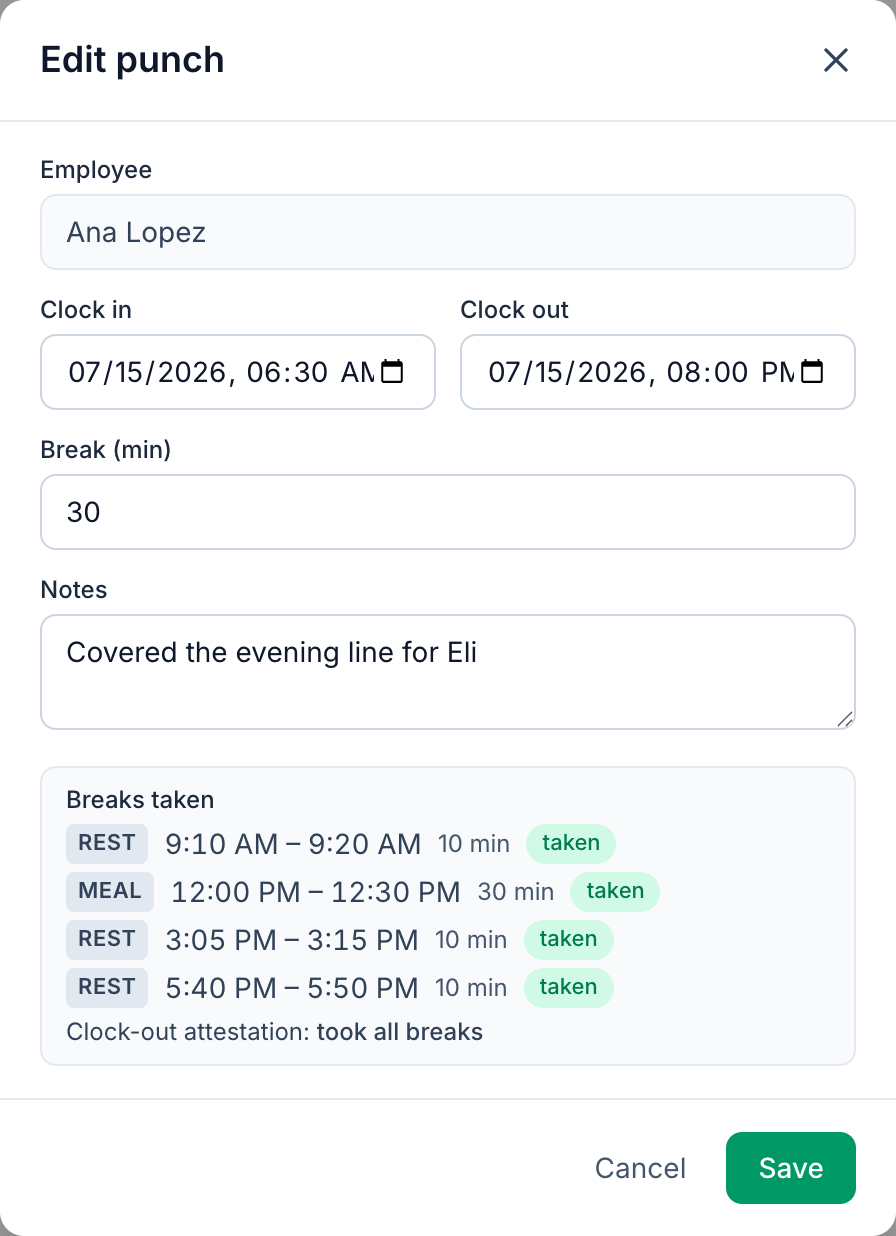
- Meal and rest periods at the time clock. Add Colorado's 30-minute meal period and paid 10-minute rest periods as custom breaks under a location's Labor & compliance card; each punch then lists the breaks taken and their length when you open it to edit. Outside California, Mays doesn't track a missed rest period or the ten minutes of pay it costs, so review punches yourself.
- Paid sick leave accrual. Under Scheduling → Settings → Time off & PTO accrual, set the Sick category to accrue Per hour worked, at least one hour for every 30 worked. The policy covers the whole organization.
Sources
Every figure on this page comes from these official pages, as they read on the date shown.
- CDLE, INFO #3C: tips (gratuities) and tipped employees under Colorado wage law, checked September 24, 2026
- CDLE, INFO #4: meal and rest periods, checked September 24, 2026
- City and County of Denver, the 2027 minimum wage (August 6, 2026), checked September 24, 2026
- CDLE, Division of Labor Standards and Statistics: annual minimum wages, checked September 24, 2026
- Colorado Department of Labor and Employment, 2026 COMPS Order poster, checked September 24, 2026
- CDLE, 2026 PAY CALC Order (7 CCR 1103-14), checked September 24, 2026
- CDLE, COMPS Order #40 (7 CCR 1103-1), checked September 24, 2026
- CDLE, INFO #1: the 2026 COMPS and PAY CALC Orders, checked September 24, 2026
- CDLE, the 2027 minimum wage (August 13, 2026), checked September 24, 2026
- US Department of Labor, Fact Sheet #15: tipped employees under the FLSA, checked September 24, 2026
- US Department of Labor, overtime pay, checked September 24, 2026
- US Department of Labor, tips under the FLSA, checked September 24, 2026
- Colorado Revised Statutes 2024, Title 8 (uncertified printout), checked September 24, 2026
- CDLE, INFO #6B: rights and obligations under the Healthy Families and Workplaces Act, checked September 24, 2026
- Colorado FAMLI, premium and benefits calculator, checked September 24, 2026
- Colorado FAMLI, small business corner, checked September 24, 2026
- CDLE, INFO #3A: timing of wage payments and required record-keeping, checked September 24, 2026
- Denver Labor, 2026 citywide minimum wage overview, checked September 24, 2026
- City of Boulder, local minimum wage, checked September 24, 2026
- Boulder County, local minimum wage, checked September 24, 2026
- CDLE, INFO #19: local minimum wages, checked September 24, 2026
This page is general information, not legal advice. Laws change, and coverage rules (your business's size, whether federal law covers you) decide which of them apply. Check the pages above, and ask an employment lawyer or accountant about your situation.
Run Colorado payroll on the right numbers
Set each position's wage, turn on the tip pool with managers left out, and let the time clock count overtime by the day and the workweek. Then payroll is an export, not an evening.
Start your free trial: 30 days, every module, no card needed. Setting up a tip pool? Read Tip pooling for new restaurant owners.