Bakery opening, closing and cleaning checklists (free template)
A bakery's day starts hours before the door opens and ends with flour on every surface. The risks aren't a café's: raw dough and flour, allergens that travel through the air, cream fillings that have to cool fast, and a case full of items customers ask about.
This template covers a small retail bakery with deck ovens, a proofer, a mixer and a refrigerated case. Every task has a Who and a Proof: a photo where seeing is the proof, a number for readings, a checkbox for the rest. For how to write tasks people follow, see our checklist guide.
This is general information, not legal advice. Check which agency licenses you and what it expects. Updated September 24, 2026: the FDA and Florida sources were re-checked against their current pages.
What makes a bakery list different
Who inspects you. In Florida, DBPR's Who needs a license? page says the Department of Agriculture and Consumer Services (FDACS) licenses bakeries, while DBPR licenses restaurants and fast food. If you also serve meals, ask both which one covers you. FDACS adopted the 2022 FDA Food Code effective April 22, 2026 (Rule 5K-4.002, F.A.C.), so the sections below are from the 2022 edition. The temperatures are the same in the 2017 edition DBPR enforces.
Allergens are the big one. The FDA's food allergies page names bakery products among the five food types most often involved in food allergen recalls. Sesame became the ninth major food allergen on January 1, 2023, and the 2022 Food Code lists it. Three rules matter for a bakery:
- Packaged items (a bagged loaf, a boxed dozen) carry a label with the food's name, the ingredients, the net quantity, your business name and address, and the food source of each major food allergen, plus nutrition labeling unless exempt (§3-602.11(A)–(B)).
- Unpackaged items in the case don't need a label under §3-602.11(D) if you make them on site, make no claims and no state or local law requires one. But the 2022 edition adds that customers must be told in writing which major food allergens an unpackaged item contains (§3-602.12(C)). Allergen cards in the case are the simple way to do it.
- Staff are trained in food allergy awareness for their duties (§2-103.11(O)).
Flour is a raw food. The FDA's flour safety page says processing grain into flour doesn't kill harmful bacteria, that raw flour, dough and batter should never be tasted, and that flour "is a powder and spreads easily". Treat flour dust as both a cleaning job and an allergen (wheat) that reaches everything nearby.
Fillings have to cool fast. Custard, pastry cream and other cooked fillings go from 135°F to 70°F within 2 hours, and to 41°F within 6 hours in total (§3-501.14(A)).
The template
Opening checklist (visible 4:00 to 7:00 am)
Group | Task | Who | Proof |
|---|---|---|---|
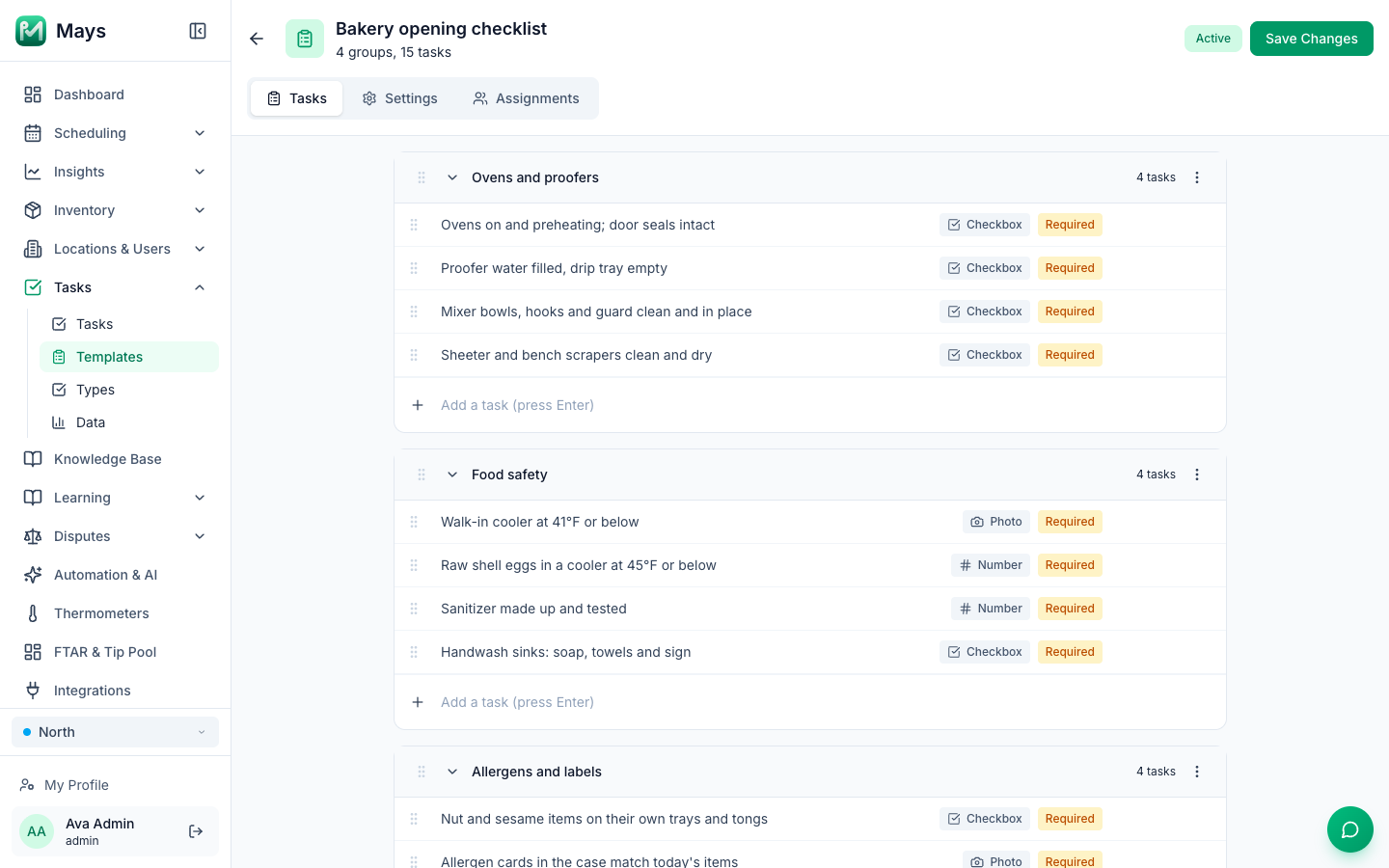
Ovens and proofers | Ovens on and preheating; door seals intact | Baker | Checkbox |
Ovens and proofers | Proofer water filled, drip tray empty | Baker | Checkbox |
Ovens and proofers | Mixer bowls, hooks and guard clean and in place | Baker | Checkbox |
Ovens and proofers | Sheeter and bench scrapers clean and dry | Baker | Checkbox |
Food safety | Walk-in cooler at 41°F or below | Baker | Photo |
Food safety | Raw shell eggs in a cooler at 45°F or below | Baker | Number |
Food safety | Sanitizer made up and tested | Baker | Number |
Food safety | Handwash sinks: soap, towels and sign | Baker | Checkbox |
Allergens and labels | Nut and sesame items on their own trays and tongs | Counter lead | Checkbox |
Allergens and labels | Allergen cards in the case match today's items | Counter lead | Photo |
Allergens and labels | Packaged items labeled with ingredients and allergens | Counter lead | Photo |
Allergens and labels | Day-old items marked or pulled | Counter lead | Checkbox |
Display case | Refrigerated case at 41°F or below | Counter lead | Number |
Display case | Case stocked; tongs and bakery tissue out | Counter lead | Checkbox |
Display case | Drawer counted and starting cash entered | Counter lead | Number |
Production checks (during the bake)
Task | Who | Proof |
|---|---|---|
Custard or pastry cream at 70°F or below within 2 hours | Baker | Number |
Same batch at 41°F or below within 6 hours | Baker | Number |
Flour and sugar bins closed, scoops handle up | Baker | Checkbox |
Hands washed and gloves changed after nut or sesame work | Baker | Checkbox |
Refrigerated case at 41°F or below | Counter lead | Number |
Cream-filled items in the case, not on the counter | Counter lead | Checkbox |
Note the time each batch starts cooling, so the 2- and 6-hour readings land on time.
Closing checklist (visible from 2:30 pm)
Group | Task | Who | Proof |
|---|---|---|---|
Ovens and equipment | Oven decks brushed; crumb trays emptied | Baker | Checkbox |
Ovens and equipment | Proofer off, wiped, drip tray emptied, door open | Baker | Checkbox |
Ovens and equipment | Mixer bowls, hooks, paddles and sheeter washed and sanitized | Porter | Checkbox |
Ovens and equipment | Sheet pans and baking tools washed | Porter | Checkbox |
Ovens and equipment | Flour dust wiped from benches, shelves and floor | Baker | Photo |
Food safety | Cream and custard items discarded or wrapped, dated and chilled | Counter lead | Checkbox |
Food safety | Doughs and batters covered, dated and in the cooler | Baker | Photo |
Food safety | Walk-in at 41°F or below at close | Baker | Number |
Food safety | Unsold bread and pastries counted and logged | Counter lead | Number |
Close | Floors swept and mopped | Porter | Checkbox |
Close | Drawer counted and total entered | Counter lead | Number |
Close | Gas off, back door locked, alarm set | Closer | Photo |
Weekly deep clean (Monday, carried through the week)
Group | Task | Who | Proof |
|---|---|---|---|
Ovens and equipment | Oven interiors cleaned per manufacturer | Baker | Checkbox |
Ovens and equipment | Proofer cleaned and descaled per manufacturer | Baker | Checkbox |
Ovens and equipment | Mixer base, bowl lift and guard degreased | Porter | Checkbox |
Ovens and equipment | Hood filters over the ovens washed | Porter | Photo |
Storage and allergens | Flour dust cleared from fridge tops, lights and vents | Porter | Photo |
Storage and allergens | Flour, nuts and seeds rotated, bins sealed | Baker | Checkbox |
Storage and allergens | Allergen cards and labels checked against recipes | Manager | Checkbox |
Storage and allergens | Walk-in shelves and floor cleaned | Porter | Checkbox |
Temperature and date checks at a glance
What | Limit | 2022 Food Code |
|---|---|---|
Refrigerated case and walk-in (cream, custard, cheesecake, dairy) | 41°F or below | §3-501.16(A)(2) |
Raw shell eggs | In a cooler at 45°F air temperature or below | §3-501.16(B) |
Cooling cooked fillings | 135°F to 70°F within 2 hours, then 41°F within 6 hours in total | §3-501.14(A) |
Ready-to-eat TCS food you make and keep over 24 hours (fillings, whipped cream) | Date-marked, 7 days at most at 41°F, prep day is Day 1 | §3-501.17(A) |
Food-contact surfaces of baking equipment | Cleaned at least every 24 hours | §4-602.12(A) |
Adapt it to your bakery
- Separate nut and sesame work by time or space. If trays, tongs and bench space can't be dedicated, bake and finish those items last, then clean down.
- Keep scoops out of the flour. In-use scoops in flour and sugar bins stay in the bin with the handle up and the lid closed (§3-304.12(B)).
- No refrigerated case? Drop the case readings, but keep the walk-in and the cooling checks if you make fillings.
- Your ovens' and proofer's manuals win for cleaning and descaling.
- Selling wholesale to cafés or grocers? Ask FDACS what that changes for your permit and labels before you start.
Load it into Mays
Each list above is one template. In the block below, a # line is a template name, a [bracketed] line is a group, and every other line is one task.
- Go to Tasks → Templates, click Create Template, type the template name and click Continue.
- Click Add Task Group, click New Group and type the group name.
- Copy one task line, paste it into Add a task (press Enter) and press Enter, one line at a time. Pasting several lines together makes them a single task.
- Click Checkbox next to a task to switch it to Photo or Number, as in the Proof column.
- On the Settings tab, set the Frequency (Daily, or Weekly with one day ticked and Carry unfinished duties through the week for the deep clean) and the Visibility Window (From and Until, in your location's time zone).
- On the Assignments tab, click your location, choose A role or department or Specific people, and click Create Template.
The image at the top of this post shows the opening checklist built that way.
# Bakery opening checklist
[Ovens and proofers]
Ovens on and preheating; door seals intact
Proofer water filled, drip tray empty
Mixer bowls, hooks and guard clean and in place
Sheeter and bench scrapers clean and dry
[Food safety]
Walk-in cooler at 41°F or below
Raw shell eggs in a cooler at 45°F or below
Sanitizer made up and tested
Handwash sinks: soap, towels and sign
[Allergens and labels]
Nut and sesame items on their own trays and tongs
Allergen cards in the case match today's items
Packaged items labeled with ingredients and allergens
Day-old items marked or pulled
[Display case]
Refrigerated case at 41°F or below
Case stocked; tongs and bakery tissue out
Drawer counted and starting cash entered

# Bakery production checks
[Production]
Custard or pastry cream at 70°F or below within 2 hours
Same batch at 41°F or below within 6 hours
Flour and sugar bins closed, scoops handle up
Hands washed and gloves changed after nut or sesame work
Refrigerated case at 41°F or below
Cream-filled items in the case, not on the counter

# Bakery closing checklist
[Ovens and equipment]
Oven decks brushed; crumb trays emptied
Proofer off, wiped, drip tray emptied, door open
Mixer bowls, hooks, paddles and sheeter washed and sanitized
Sheet pans and baking tools washed
Flour dust wiped from benches, shelves and floor
[Food safety]
Cream and custard items discarded or wrapped, dated and chilled
Doughs and batters covered, dated and in the cooler
Walk-in at 41°F or below at close
Unsold bread and pastries counted and logged
[Close]
Floors swept and mopped
Drawer counted and total entered
Gas off, back door locked, alarm set

# Bakery weekly deep clean
[Ovens and equipment]
Oven interiors cleaned per manufacturer
Proofer cleaned and descaled per manufacturer
Mixer base, bowl lift and guard degreased
Hood filters over the ovens washed
[Storage and allergens]
Flour dust cleared from fridge tops, lights and vents
Flour, nuts and seeds rotated, bins sealed
Allergen cards and labels checked against recipes
Walk-in shelves and floor cleaned
Admins can hand the whole block to Mays AI instead: click Import from Document on the Task Templates page, paste the block into the chat (or attach it as a .txt file), review the drafts under Drafts, and click Approve & save. It uses AI credits.
New templates start the next day; Tasks → Tasks → Create Task → From Template runs one today.
Where Mays fits
- A photo of the allergen cards every morning, taken in the app's camera, shows the case matched the day's bake. AI photo verification (an organization setting that uses AI credits) can flag a photo that doesn't show what the task asked for.
- Number answers for the cooling checks keep each reading with who took it and when.
- Managers reject a task with a reason, and it goes back on the list to redo.
- Your allergen matrix and recipes can live in the knowledge base, next to the checklists that use them.
Start baking with a checklist
Build the four templates tonight and tomorrow's 4 am bake starts with the ovens, the eggs and the allergen cards checked.
Start your free trial: 30 days, every module, no card needed. Or book a walkthrough and we'll load your bakery's checklists with you.