San Diego restaurant pay rules (2026): wages, tips, scheduling and sick leave
San Diego's voters set the city's minimum wage in 2016, and it has risen with the cost of living every January since 2019: $17.75 an hour in 2026, for every employer and industry, with no exceptions and no credit for tips (San Diego). It applies inside city limits only, so a café just outside the city line follows California's rate instead. The same ordinance gives every employee earned sick leave as they work.
This page puts what a restaurant or café in San Diego owes in one place: the city's own rules first, then the California and federal rules that apply in San Diego as everywhere else in the state, two example weeks with the math shown, and what Mays does with each. Every figure links to the official page it comes from.
Updated October 5, 2026: these figures are still current. San Diego's minimum wage is $17.75 an hour, and tipped employees get the same through December 31, 2026. It rises to $18.35, for tipped employees too, on January 1, 2027 (San Diego).
This is general information, not legal advice. Whether a rule applies can depend on your business's size and your own facts; the note at the end says more.
San Diego pay rules at a glance
As of September 21, 2026:
Rule | San Diego |
|---|---|
Minimum wage | $17.75 an hour, since January 1, 2026 |
Tipped employees | The full minimum wage: no tip credit in San Diego |
Next change | Changes on January 1, 2027; the new rate is in the update above |
Overtime | 1.5× the regular rate after 40 hours in a workweek, and after 8 hours in a day; double time after 12 hours in a day; special rules for the seventh day in a row in a workweek (California and federal law) |
Fair workweek scheduling | No San Diego or California law in our data |
Paid sick leave | San Diego's own ordinance; see Paid sick leave below |
Sources: San Diego; DLSE, minimum wage; DLSE, overtime.
Who San Diego's rate covers: All employers, all industries; employees who perform 2+ hours of work in a calendar week within City of San Diego boundaries.
San Diego vs. California: what the city changes
Where San Diego sets a rule of its own, it applies on top of California's, and an employer follows whichever gives the employee more. Here are the two side by side:
Rule | California | San Diego |
|---|---|---|
Minimum wage | $16.90 (DLSE, minimum wage) | $17.75 (San Diego) |
Tipped employees | No tip credit (DLSE, minimum wage) | No tip credit, as statewide |
Next change (as of October 5, 2026) | $17.40 on January 1, 2027 (DIR, 2027 minimum wage) | $18.35 minimum wage from January 1, 2027 (San Diego) |
Paid sick leave | 1 hour per 30 hours worked (alternative accrual allowed if it yields 24 h by day 120 and 40 h by day 200) (DLSE, paid sick leave) | 1 hour per 30 hours worked (or 40 hours front-loaded each benefit year) (San Diego) |
Fair workweek scheduling | No state law in our data | No city law in our data |
Our data has no San Diego rule of its own on overtime, breaks, tip pools or food handler training, so the California and federal rules below apply in San Diego as they do across the state. For California's rules in full, with their own worked examples, see California restaurant pay rules (2026).
What you must pay tipped staff in San Diego
California doesn't allow a tip credit (DLSE, minimum wage), so servers, bartenders and baristas who get tips must be paid at least the full $17.75 an hour in wages, and their tips are all theirs, on top. There's no tipped cash wage and no weekly tip make-up to calculate.
What you must pay non-tipped staff in San Diego
Cooks, dishwashers, prep cooks, and cashiers or counter staff who don't get tips are paid like any other hourly employee:
- At least $17.75 an hour for every hour worked (San Diego). No tip credit applies.
- Overtime is at least 1.5 times their regular rate for hours over 40 in a workweek or 8 in a day. At $17.75 an hour, that's $26.625 (DLSE, overtime).
Worked examples (made-up numbers)
The names, hours and tips below are made up. The rates are the ones that apply in San Diego as of September 21, 2026.
A server's week
Sam is a server in San Diego. For a 30-hour week you pay him at least 30 × $17.75 = $532.50 in wages, before tips. His tips are all on top, whatever they come to; there's no make-up to calculate.
A cook's week with overtime
Ana is a line cook in San Diego paid the minimum wage, $17.75 an hour. She works five 9-hour days: 45 hours.
Hours | Rate | Pay | |
|---|---|---|---|
Regular hours | 40 | $17.75 | $710.00 |
Overtime hours (daily and weekly) | 5 | $26.625 (1.5 × $17.75) | $133.13 |
Total | 45 | $843.13 |
California counts overtime by the day too: hours past 8 in a day are paid at 1.5 times the regular rate, and hours past 12 at double time, however short the week (DLSE, overtime). Overtime is counted by the workweek, and hours can't be averaged across two weeks: a long week earns overtime even if the next one is short (US DOL, overtime). Bonuses can change the rate too; see Time clock, breaks and overtime: first-month payroll mistakes to avoid.
Scheduling rules in San Diego
We found no San Diego or California fair workweek law in our data: nothing here makes you post schedules a set number of days ahead or pay a premium for changing them. Breaks and overtime still shape the schedule (see below).
Paid sick leave in San Diego
San Diego has a paid sick leave ordinance of its own (San Diego):
- How it's earned: 1 hour per 30 hours worked (or 40 hours front-loaded each benefit year).
- Who it covers: All employers; employees who perform 2+ hours of work in a calendar week in the City of San Diego.
- What else it requires: Employees earn 1 hour for every 30 hours worked. The employer may cap the total at 80 hours, and unused leave carries forward. Front-loading 40 hours at the start of each benefit year satisfies the rule. Use may be limited to 40 hours per benefit year. It covers safe time too.
California's paid sick leave law applies in San Diego too (DLSE, paid sick leave): Healthy Workplaces, Healthy Families Act. Since January 1, 2024, employers must allow use of at least 40 hours or 5 days per year (whichever is more). Employer may cap total accrual at 80 hours / 10 days; carryover required under accrual plans. Up-front (frontload) plans must grant the full 40 h / 5 days at the start of each year. Local ordinances (SF, LA, Oakland, etc.) may require more. For each term, how fast leave is earned, how much can be used, how much carries over and how soon a new hire can use it, follow whichever of the two is more generous.
Tip pools, overtime and breaks in San Diego
These are California's rules, with the federal ones where California sets none, and they apply in San Diego as they do across the state:
- Tip pools: California allows mandatory tip pools that are "fair and reasonable" among staff in the "chain of service". Owners, managers and supervisors can never share, even if they serve tables. Employers may not deduct card-processing fees from tips, must pay card tips by the next regular payday, and cannot take a tip credit (DLSE, tips). Under federal law, the business, its managers and supervisors never keep employees' tips, and with a tip credit a pool you require can include only staff who customarily and regularly receive tips (US DOL, tips).
- Service charges: A mandatory "service charge" may or may not be a gratuity; it depends on whether customers perceive and intend it as one (DLSE, tips).
- Overtime: 1.5x for hours over 8 and up to 12 in a workday, over 40 in a workweek, and the first 8 hours on the 7th consecutive workday. 2x for hours over 12 in a workday and over 8 on the 7th consecutive workday. Overtime is owed whether or not it was authorized. Alternative workweek schedules adopted under the Labor Code have different rules (DLSE, overtime).
- Meal breaks: 30-minute meal period when the work period is more than 5 hours, provided no later than the end of the 5th hour; a second 30-minute meal period when working more than 10 hours, no later than the end of the 10th hour. First meal may be waived by mutual consent only if the whole workday is 6 hours or less; second may be waived only if total hours are 12 or less and the first was not waived. Unpaid only if the employee is relieved of all duty and free to leave the premises; an on-duty (paid) meal period is allowed only when the nature of the work objectively prevents relief and there is a written agreement the employee can revoke in writing at any time. Missed, late or short meal period = 1 additional hour of pay at the regular rate per workday. Restaurants are covered by IWC Wage Order 5 (public housekeeping). All employer sizes (DLSE, meal periods).
- Rest breaks: Net 10-minute paid rest period per 4 hours worked "or major fraction thereof" (DLSE treats more than 2 hours as a major fraction), as near the middle of each work period as practicable. Not required when total daily work time is under 3.5 hours. So: 1 break for 3.5 to 6 hours, 2 for more than 6 up to 10, 3 for more than 10 up to 14. Rest time counts as hours worked. Missed rest period(s) = 1 additional hour of pay at the regular rate per workday (one premium per day for rest, separate from the meal premium). Employees cannot trade rest breaks to leave early (DLSE, rest periods).
- Minors' breaks: No separate California rule for minors; the adult rules above apply to them too (IWC Wage Order 5).
Other rules that affect pay in San Diego
- Reporting-time pay: If an employee reports but is not put to work, or gets less than half the usual or scheduled day's work, pay half the scheduled day: at least 2 and at most 4 hours at the regular rate (never below minimum wage). If an employee is called back a second time in one workday and gets less than 2 hours, pay 2 hours. Exceptions: threats to employees or property, civil-authority recommendation, utility failure, or an Act of God or other cause outside the employer's control. It also does not apply to paid standby or to regularly scheduled shifts under 2 hours. Reporting can happen by phoning in before a shift (Ward v. Tilly's) (DLSE, reporting time pay).
- Split shifts and spread of hours: A split shift is a schedule interrupted by unpaid, non-working periods set by the employer, other than bona fide rest or meal periods. Each workday with one earns an extra hour of pay at the minimum wage (the state or local rate, whichever is higher), except for employees who live at the place of employment. Pay above the minimum wage counts toward it, so the employer owes only what the day's pay falls short of the minimum wage for every hour worked plus that extra hour. Picking up an extra shift voluntarily doesn't count (DLSE, split shifts).
- Food handler training: Every food employee needs approved food-safety training. Who: food handlers at food facilities, within 30 days of hire; card valid 3 years (Health & Safety Code § 113948).
How Mays handles this
Mays runs the schedule, time clock, tip pool and payroll export for each location. For a restaurant in San Diego, that means:
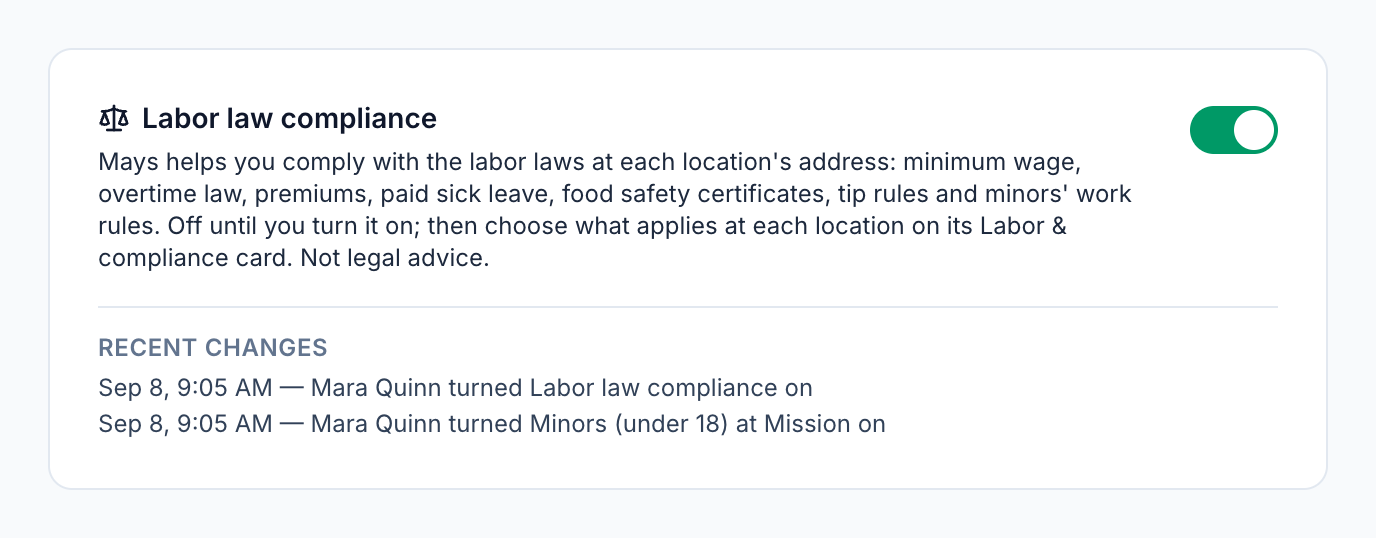
- The minimum wage for the address. Turn on Labor law compliance and Mays reads each location's minimum wage from its address: a location whose city is San Diego gets San Diego's $17.75. It warns you when a position's default wage, someone's hourly wage or a punch is below it, and never blocks the save. It switches to the new rate on January 1, 2027 by itself, and admins get a reminder 30 and 7 days before, listing the wages below the new rate.
- Paid sick leave per location. With Labor law compliance on, the Sick category under Scheduling → Settings → Time off & PTO accrual shows the paid sick leave law at each location's address, and Apply these rules fills in its figures, starting with at least one hour for every 30 worked (San Diego). Where San Diego's and California's figures differ, it takes the more generous one. If the location's address doesn't name San Diego, pick San Diego under Where this location is. Everyone who works hours earns it from approved punches, managers included, and a figure Mays doesn't have is left open for you to fill in from the official page.
- Overtime by the address. Staff clock in on their phone, a shared kiosk or an NFC tag, and timesheets run by pay period. Overtime is counted by the workweek, and with Labor law compliance on, by any daily, double-time and seventh-day rule California sets too, which Mays reads from the location's address; the schedule's labor cost, the reports and the pay summary all include it.
- Reporting-time pay. Turn on Labor law compliance and Mays applies California's rule at each location from its address and records it when a punch is clocked out, each in its own column of the pay summary and the payroll export.
- A tip pool per location. Split pooled tips by hours worked, equally or by FTAR score, and choose which positions receive. Leave managers and admins out of the pool is on by default, so leave it on. California doesn't allow taking card processing fees out of tips, so leave Deduct the card processing fee from card tips off: with Labor law compliance on, the card warns you if it's on. Each person's share appears in the Tip Payouts report and the payroll export.
- Food handler cards. Turn on Labor law compliance and keep each person's card in Mays with its expiry date and a photo. Each location shows who has no card by the 30-day deadline after their hire date and whose card is about to expire, and Mays reminds the employee and their managers before a card expires.
Sources
Every figure on this page comes from these official pages, as they read on the date shown.
- City of San Diego, minimum wage and earned sick leave, checked October 5, 2026
- California Labor Commissioner (DLSE), minimum wage FAQ, checked September 24, 2026
- California Labor Commissioner (DLSE), overtime FAQ, checked September 24, 2026
- California DIR, news release 2026-66: the 2027 minimum wage, checked September 24, 2026
- California Labor Commissioner (DLSE), paid sick leave, checked September 24, 2026
- US Department of Labor, overtime pay, checked September 24, 2026
- California Labor Commissioner (DLSE), tips and gratuities FAQ, checked September 24, 2026
- US Department of Labor, tips under the FLSA, checked September 24, 2026
- California Labor Commissioner (DLSE), meal periods FAQ, checked September 24, 2026
- California Labor Commissioner (DLSE), rest periods FAQ, checked September 24, 2026
- IWC Wage Order 5, public housekeeping industry (restaurants), checked September 24, 2026
- California Health and Safety Code § 113948, checked September 24, 2026
- California Labor Commissioner (DLSE), reporting time pay FAQ, checked September 24, 2026
- California Labor Commissioner (DLSE), split shift FAQ, checked September 24, 2026
This page is general information, not legal advice. Laws change, and coverage rules (your business's size, whether federal law covers you) decide which of them apply. Check the pages above, and ask an employment lawyer or accountant about your situation.
Run San Diego payroll on the right numbers
Give each location its San Diego address, turn on Labor law compliance so the minimum wage, overtime and sick leave rules follow it, and let the time clock do the counting. Then payroll is an export, not an evening.
Start your free trial: 30 days, every module, no card needed. Running more than one city? Each location reads its own rules.