Saint Paul restaurant pay rules (2026): wages, tips, scheduling and sick leave
Saint Paul's minimum wage depends on the size of the business, and a restaurant counts its size its own way. Since July 1, 2026, every business with more than 5 employees pays at least $16.37 an hour, and a micro business pays $14.25 (Saint Paul). A full-service restaurant with fewer than 10 locations nationwide counts each location's employees on their own, so a small local group can be a small business at every address. Tips never count toward the wage, and sick and safe time starts on the first day of work.
This page puts what a restaurant or café in Saint Paul owes in one place: the city's own rules first, then the Minnesota and federal rules that apply in Saint Paul as everywhere else in the state, two example weeks with the math shown, and what Mays does with each. Every figure links to the official page it comes from.
Updated October 5, 2026: these figures are still current. Saint Paul's minimum wage is $16.37 an hour, and tipped employees get the same through December 31, 2026. It rises to $17.02, for tipped employees too, on January 1, 2027 (Saint Paul, 2027 rates).
This is general information, not legal advice. Whether a rule applies can depend on your business's size and your own facts; the note at the end says more.
Saint Paul pay rules at a glance
As of July 6, 2026:
Rule | Saint Paul |
|---|---|
Minimum wage | $16.37 an hour, since July 1, 2026 |
Tipped employees | The full minimum wage: no tip credit in Saint Paul |
Next change | Changes on January 1, 2027; the new rate is in the update above |
Overtime | 1.5× the regular rate after 40 hours in a workweek; no daily overtime (Minnesota and federal law) |
Fair workweek scheduling | No Saint Paul or Minnesota law in our data |
Paid sick leave | Saint Paul's own ordinance; see Paid sick leave below |
Sources: Saint Paul; Saint Paul, 2027 rates; US DOL, overtime; Saint Paul, workplace poster.
Who Saint Paul's rate covers: hours worked within Saint Paul; the rate depends on business size, counting employees outside Saint Paul too (a full-service restaurant with fewer than 10 locations nationwide counts each location separately).
Other Saint Paul rates:
- macro businesses (10,001 or more employees) and the City of Saint Paul: $16.37 an hour
- large businesses (101 to 10,000 employees): $16.37 an hour
- small businesses (6 to 100 employees): $16.37 an hour
- micro businesses (5 or fewer employees): $14.25 an hour
- employees aged 14 to 17, for 90 days after they're hired (85% of the small-business rate): $13.95 an hour
Saint Paul raises its rates in two steps: businesses with more than 100 employees move each January, and small and micro businesses follow in July (Saint Paul, 2027 rates). So the January 1, 2027 change in the update above is for the larger businesses; a small business keeps paying $16.37 until July 1, 2027.
Saint Paul vs. Minnesota: what the city changes
Where Saint Paul sets a rule of its own, it applies on top of Minnesota's, and an employer follows whichever gives the employee more. Here are the two side by side:
Rule | Minnesota | Saint Paul |
|---|---|---|
Minimum wage | $11.41 (MN DLI, minimum wage) | $16.37 (Saint Paul) |
Tipped employees | No tip credit (MN DLI, minimum wage) | No tip credit (Saint Paul) |
Next change (as of October 5, 2026) | $11.87 on January 1, 2027 (MN DLI, minimum wage) | $17.02 minimum wage from January 1, 2027 (Saint Paul, 2027 rates) |
Paid sick leave | 1 hour per 30 hours worked (MN DLI, sick and safe time) | 1 hour per 30 hours worked (Saint Paul, workplace poster) |
Fair workweek scheduling | No state law in our data | No city law in our data |
Our data has no Saint Paul rule of its own on overtime, breaks, tip pools or food handler training, so the Minnesota and federal rules below apply in Saint Paul as they do across the state. For Minnesota's rules in full, with their own worked examples, see Minnesota restaurant pay rules (2026).
What you must pay tipped staff in Saint Paul
Saint Paul doesn't allow a tip credit (Saint Paul), so servers, bartenders and baristas who get tips must be paid at least the full $16.37 an hour in wages, and their tips are all theirs, on top. There's no tipped cash wage and no weekly tip make-up to calculate.
Minnesota bans the tip credit statewide (MN DLI, minimum wage), and Saint Paul's ordinance says the same for the city's rate: an employer "must not directly or indirectly credit, apply, or utilize gratuities" toward it (Saint Paul ch. 224).
What you must pay non-tipped staff in Saint Paul
Cooks, dishwashers, prep cooks, and cashiers or counter staff who don't get tips are paid like any other hourly employee:
- At least $16.37 an hour for every hour worked (Saint Paul). No tip credit applies.
- Overtime is at least 1.5 times their regular rate for hours over 40 in a workweek. At $16.37 an hour, that's $24.555 (US DOL, overtime).
New hires aged 14 to 17
For the first 90 days after they're hired, workers aged 14 to 17 can be paid 85% of the small-business rate, rounded up to the nearest nickel: $13.95 an hour since July 1, 2026 (Saint Paul). After that, they get the full rate for the business's size.
Worked examples (made-up numbers)
The names, hours and tips below are made up. The rates are the ones that apply in Saint Paul as of July 6, 2026.
A server's week
Sam is a server in Saint Paul. For a 30-hour week you pay him at least 30 × $16.37 = $491.10 in wages, before tips. His tips are all on top, whatever they come to; there's no make-up to calculate.
A cook's week with overtime
Ana is a line cook in Saint Paul paid the minimum wage, $16.37 an hour. She works five 9-hour days: 45 hours.
Hours | Rate | Pay | |
|---|---|---|---|
Regular hours | 40 | $16.37 | $654.80 |
Overtime hours (over 40) | 5 | $24.555 (1.5 × $16.37) | $122.78 |
Total | 45 | $777.58 |
Overtime is counted by the workweek, and hours can't be averaged across two weeks: a long week earns overtime even if the next one is short (US DOL, overtime). Bonuses can change the rate too; see Time clock, breaks and overtime: first-month payroll mistakes to avoid.
Scheduling rules in Saint Paul
We found no Saint Paul or Minnesota fair workweek law in our data: nothing here makes you post schedules a set number of days ahead or pay a premium for changing them. Breaks and overtime still shape the schedule (see below).
Paid sick leave in Saint Paul
Saint Paul has a paid sick leave ordinance of its own (Saint Paul, workplace poster):
- How it's earned: 1 hour per 30 hours worked.
- Who it covers: every employer; full-time, part-time, temporary and paid on-call employees the employer expects to work at least 80 hours a year in Saint Paul.
- What else it requires: Earned sick and safe time under chapter 233 of the Saint Paul Legislative Code: accrual starts on the first day of work, up to 48 hours a year, and up to 80 hours can be carried over after the first year. An employer can front-load 48 hours and pay out what is unused at year end, or front-load 80 hours with no payout. An employer may ask for documentation only for an absence of more than 2 consecutive scheduled workdays.
Minnesota's paid sick leave law applies in Saint Paul too (MN DLI, sick and safe time): Earned sick and safe time: an employee earns 1 hour for every 30 hours worked, up to 48 hours a year unless the employer agrees to more, and it's paid at the same base rate they earn when working. Minneapolis and Saint Paul have their own ordinances, and employers follow the requirements most favorable to their employees. For each term, how fast leave is earned, how much can be used, how much carries over and how soon a new hire can use it, follow whichever of the two is more generous.
Tip pools, overtime and breaks in Saint Paul
These are Minnesota's rules, with the federal ones where Minnesota sets none, and they apply in Saint Paul as they do across the state:
- Tip pools: Minnesota bans tip pools the employer requires. Employees may share tips only voluntarily, by an agreement they make among themselves without the employer’s coercion or participation; at their request, the employer may hold the shared tips and pay them out. The full amount of a tip paid by card or other electronic payment goes to the employee no later than the next scheduled pay period. There is no tip credit (Minn. Stat. § 177.24). Under federal law, the business, its managers and supervisors never keep employees' tips, and with a tip credit a pool you require can include only staff who customarily and regularly receive tips (US DOL, tips).
- Service charges: An obligatory charge that a customer might reasonably see as payment for personal service (service charge, tip, gratuity, surcharge) is a gratuity belonging to the employee, unless the employer gives clear and conspicuous notice that it is not the employee’s property: bold type on the menu, a placard, the front of the bill or other printed material, at least 18-pt on a placard or 9-pt on other notices (Minn. Stat. § 177.24).
- Overtime: Time and a half for hours over 48 in a workweek (Minn. Stat. 177.25), unless the employee is exempt under section 177.23, subdivision 7. Holiday, vacation and sick hours don't count toward the 48. Employers the federal Fair Labor Standards Act covers, such as businesses with gross annual sales of more than $500,000, must pay overtime for all hours over 40 in a workweek (MN DLI, overtime). The federal rule, time and a half after 40 hours, still binds an employer it covers (US DOL, overtime).
- Meal breaks: A meal break of at least 30 minutes for an employee working 6 or more consecutive hours; the law doesn't require a second one on a long shift. The employer can require staff to stay on the premises during breaks. A missed break is owed at the employee's regular rate plus an equal amount as damages, and a collective bargaining agreement can set different meal periods (Minn. Stat. § 177.254).
- Rest breaks: A rest break of at least 15 minutes, or enough time to use the nearest convenient restroom if that's longer, within each 4 consecutive hours of work; a break after the fourth hour doesn't count. A break shorter than 20 minutes is paid time. A missed break is owed at the employee's regular rate plus an equal amount as damages, and a collective bargaining agreement can set different rest breaks (Minn. Stat. § 177.253).
- Minors' breaks: No separate Minnesota rule for minors; the adult rules above apply to them too (Minn. Stat. § 181A.04).
Other rules that affect pay in Saint Paul
- Food handler training: A certified food protection manager is required, not a card for every employee. Who: at least one certified food protection manager per establishment (not every food employee) (MDH, food manager requirement).
How Mays handles this
Mays runs the schedule, time clock, tip pool and payroll export for each location. For a restaurant in Saint Paul, that means:
- The minimum wage for the address. Turn on Labor law compliance and Mays reads each location's minimum wage from its address: a location whose city is Saint Paul gets Saint Paul's $16.37. It warns you when a position's default wage, someone's hourly wage or a punch is below it, and never blocks the save. It switches to the new rate on January 1, 2027 by itself, and admins get a reminder 30 and 7 days before, listing the wages below the new rate.
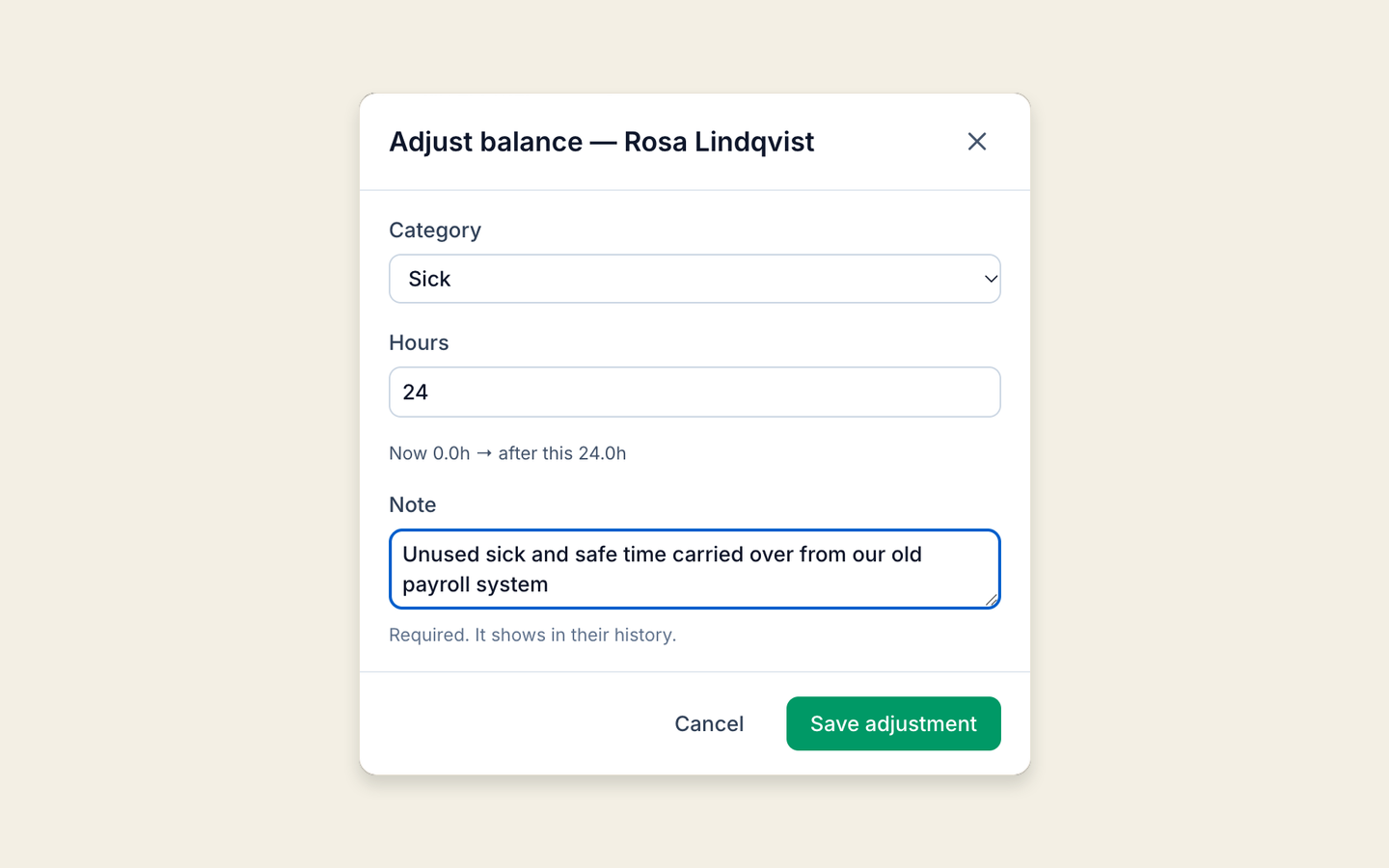
- Paid sick leave per location. With Labor law compliance on, the Sick category under Scheduling → Settings → Time off & PTO accrual shows the paid sick leave law at each location's address, and Apply these rules fills in its figures, starting with at least one hour for every 30 worked (MN DLI, sick and safe time). Mays has Minnesota's figures, not Saint Paul's own, so check the city's against the ordinance above and raise any that fall short. If the location's address doesn't name Saint Paul, pick Saint Paul under Where this location is. Everyone who works hours earns it from approved punches, managers included, and a figure Mays doesn't have is left open for you to fill in from the official page.
- Overtime by the address. Staff clock in on their phone, a shared kiosk or an NFC tag, and timesheets run by pay period. Overtime is counted by the workweek, and with Labor law compliance on, by any daily, double-time and seventh-day rule Minnesota sets too, which Mays reads from the location's address; the schedule's labor cost, the reports and the pay summary all include it.
- A tip pool per location. Split pooled tips by hours worked, equally or by FTAR score, and choose which positions receive. Leave managers and admins out of the pool is on by default, so leave it on. Minnesota doesn't allow taking card processing fees out of tips, so leave Deduct the card processing fee from card tips off: with Labor law compliance on, the card warns you if it's on. Each person's share appears in the Tip Payouts report and the payroll export.
- Food protection manager certificate. Turn on Labor law compliance and keep your certified manager's certificate in Mays with its expiry date. Each location shows whether someone there holds a valid one, and Mays reminds them and their managers before it expires.
- Smaller businesses' rates. Mays applies the rate for businesses with more than 100 employees, and moves to their new rate each January. A micro business (5 or fewer employees) can turn on Use a different minimum for this location on the location's Labor & compliance card and enter $14.25, and a small business can do the same from January 1, 2027 to June 30, 2027, while its rate stays behind; the below-minimum warnings use that figure instead.
Sources
Every figure on this page comes from these official pages, as they read on the date shown.
- City of Saint Paul, minimum wage, checked October 5, 2026
- City of Saint Paul, minimum wage rates for 2027 (September 1, 2026), checked October 5, 2026
- US Department of Labor, overtime pay, checked September 24, 2026
- City of Saint Paul, labor standards workplace poster (updated August 2026), checked October 5, 2026
- Minnesota Department of Labor and Industry, minimum wage, checked September 24, 2026
- Minnesota DLI, earned sick and safe time, checked September 24, 2026
- Saint Paul Legislative Code chapter 224 (minimum wage), as amended in effect November 16, 2025, checked October 5, 2026
- Minnesota Statutes § 177.24, checked September 24, 2026
- US Department of Labor, tips under the FLSA, checked September 24, 2026
- Minnesota DLI, overtime, checked September 24, 2026
- Minnesota Statutes § 177.254, checked September 24, 2026
- Minnesota Statutes § 177.253, checked September 24, 2026
- Minnesota Statutes § 181A.04, checked September 24, 2026
- Minnesota Department of Health, certified food protection manager requirements, checked September 24, 2026
This page is general information, not legal advice. Laws change, and coverage rules (your business's size, whether federal law covers you) decide which of them apply. Check the pages above, and ask an employment lawyer or accountant about your situation.
Run Saint Paul payroll on the right numbers
Give each location its Saint Paul address, turn on Labor law compliance so the minimum wage, overtime and sick leave rules follow it, and let the time clock do the counting. Then payroll is an export, not an evening.
Start your free trial: 30 days, every module, no card needed. Running more than one city? Each location reads its own rules.